
10 words for God's 10 words - part 1
By Gerry Straker, 07 Feb 2024

This Spring 2024 at Church by the Bay for 10 weeks we are looking at the 10 words from Exodus 20:1-17 on Wednesdays in our C3 teams. 10 words? It’s what the Bible calls the 10 commandments (Exodus 34:28; Deuteronomy 4:13; 10:4) or sometimes they are just called ‘words’ (Deuteronomy 4:10, 36; 5:22).
People love to update these commandments:
- Thou shalt not shrink-wrap cucumbers.
- Thou shalt not consume thine own body weight in fudge.
- Thou shalt not be negative!
After all the 10 words are not set in stone are they…?
Of course they are literally set in stone – inscribed by the finger of God (Exodus 31:18). Christians believe the Bible is God’s Word and know the 10 words are therefore important, but we often get confused about how they are important for us today. To help us, I’ve got 10 words for God's 10 words. My words don't cover all there is to say, and you may well prefer other words to the particular ones I’ve chosen. That’s totally fine. But I hope my 10 words will help you begin to see more of how important and massive God’s 10 words are.
This article looks at five words. The second article looks at another five words.
1. SERIOUS
This is what happens immediately after the 10 words are given in Exodus 20:18-20:
18 When the people saw the thunder and lightning and heard the trumpet and saw the mountain in smoke, they trembled with fear. They stayed at a distance 19 and said to Moses, "Speak to us yourself and we will listen. But do not have God speak to us or we will die." 20 Moses said to the people, "Do not be afraid. God has come to test you, so that the fear of God will be with you to keep you from sinning."
God’s people are at the foot of Mount Sinai with thunder, lightning, trumpet and smoke. It's no wonder they are terrified - God has put the fear of God into them! God is not a twinkly-eyed granddad who spoils the grandkids rotten, who lets them get away with murder, who… worships them. No, God is to be worshipped; God is to be feared! This is so that they keep from sinning (verse 20) and to help them obey Him. God wants them to obey because he loves them and wants them to enjoy his blessing!
This fear is a good kind of fear: it's awe, honour, respect. In verse 20, Moses says: ’Don’t be afraid.’ It is as if Moses says: Don’t have abject terror, the fear that comes from having God as your enemy. No, God loves you! But, on the other hand they are to fear God as their God. They are to have the kind of fear, the reverent awe, that means they will listen to Him and obey Him! God is the saving, loving, fearsome lawgiver.
The 10 words are serious. God is serious about his 10 words. They were serious about the 10 words. We should be too.
2. CREATIONAL
By this word creational l mean they are not new, they are ancient. The 10 words were built into creation. The 10 words are a ‘republication’ of the law of Adam and the law of Abraham.
a. The Law of Adam
Here are the simplified 10 words:
|
The 10 words |
||
|
Exodus 20:3 |
1 |
No other gods |
|
Exodus 20:4-6 |
2 |
No images |
|
Exodus 20:7 |
3 |
Don’t misuse the Lord’s name |
|
Exodus 20:8-11 |
4 |
Keep the Sabbath |
|
Exodus 20:12 |
5 |
Honour your parents |
|
Exodus 20:13 |
6 |
No murder |
|
Exodus 20:14 |
7 |
No adultery |
|
Exodus 20:15 |
8 |
No stealing |
|
Exodus 20:16 |
9 |
No lying |
|
Exodus 20:17 |
10 |
No coveting |
These 10 words are implied in the early chapters of Genesis:
- Word 1 God created the heavens (the spiritual realm) and the earth (the material realm) in Genesis 1:1. God is the only God; He is God of everything!
- Word 2 God created people in his image (Genesis 1:31). God is the one who makes images of Himself; we are his images and are not to craft other images.
- Word 3 In the garden (Genesis 2:4-3:24) the LORD’s name (given to Moses later in Exodus 3:13-16) is used for God, except when the serpent and Eve are talking - which is when the LORD’s name is not being honoured!
- Word 4 The Sabbath day of rest is built into Creation (Genesis 2:1-3).
- Word 5 ‘Adam named his wife Eve, because she would become the mother of all the living.’ (Genesis 3:20). Cain clearly did not honour his parents when he killed his brother Abel (Genesis 4:8).
- Word 6 Cain murdered his brother (Genesis 4:8).
- Word 7 Marriage of Adam and Eve is established (Genesis 2:20-25).
- Word 8 They steal the fruit (Genesis 2:17; 3:6).
- Word 9 We know the serpent is the father of lies (John 8:44). And after Adam and Eve listen to him instead of God, Adam and Eve gave false testimony as Adam blames Eve and the LORD, and Eve blames the serpent (Genesis 3:12-13).
- Word 10 Eve covets the fruit (Genesis 3:6).
All the 10 commandments are there at the beginning. In the fourth commandment - keep the Sabbath - we are actually taken back to creation (Exodus 20:8-11). The 10 words are not new, they are built into creation. Samuel Petto, a Puritan writer, argues that at the Fall, Adam broke every one of the 10!
But the 10 words are not just implied in and around the garden...
b. The Law of Abraham
You can find the 10 commandments after the flood and before Mount Sinai for Abraham and his family. I’ve put the references in this table if you would like to see for yourself:
|
The 10 words after the flood and before Sinai |
||
|
Genesis 12:4 (see Joshua 24:2-3); Exodus 18:11 |
1 |
No other gods |
|
Genesis 31:34; 35:2 |
2 |
No images |
|
Genesis 9:26; 15:8; 22;14, 24:3, 24:7, 27:27 |
3 |
Don’t misuse the Lord’s name |
|
Exodus 16:22-30 |
4 |
Keep the Sabbath |
|
Genesis 9:20-27 |
5 |
Honour your parents |
|
Genesis 9:6 |
6 |
No murder |
|
Genesis 12:10-20; 20:1-18; 26:6-11; 39:9. See also Leviticus 18:24-27) |
7 |
No adultery |
|
Genesis 44:1-12 |
8 |
No stealing |
|
Genesis 29:18-26[1] |
9 |
No lying |
|
Genesis 37:11 |
10 |
No coveting |
As the man of faith Abraham was expected to obey God’s law and he does: ‘Abraham obeyed my voice and kept my charge, my commandments, my statutes, and my laws.’ (Genesis 26:5). Notice that Abraham heard God’s voice just like the people did at Sinai[2]. And all the terms used for the law, are used of the 10 words.
So the 10 words are not new! They are a ‘republication’ of commandments already given – in a very special way for the redeemed people of God. It’s like the official public announcement of news that was already known.
After all, Exodus is the story of God bringing his people out of slavery, and inviting them back home with him. As they are welcomed back home, these are the house rules.
Here at Mount Sinai, they were specially given to Israel, not because they weren’t for everyone, but because they were for everyone. They were for all people to obey. Israel were to be a kingdom of priests (Exodus 19:6) showing the world what it meant to live as God’s people.
The 10 words are built into creation, and for everyone.
3. POST-SALVATION
The 10 words are introduced like this: '"And God spoke all these words: "I am the LORD your God, who brought you out of Egypt, out of the land of slavery.”’ (Exodus 20:1-2). The LORD has rescued his people. He:
- carried them on eagle’s wings.
- brought them to Himself.
- desires them to be
- His treasured possession
- His Kingdom of priests
- His holy nation. (Exodus 19:5-6)
The LORD has done all this and then wants to saved people to obey. We need to be clear about the order. The 10 words are given in this particular and clear way from heaven for a redeemed people, rescued from slavery to an evil tyrant in Egypt.
Exodus has three peaks:
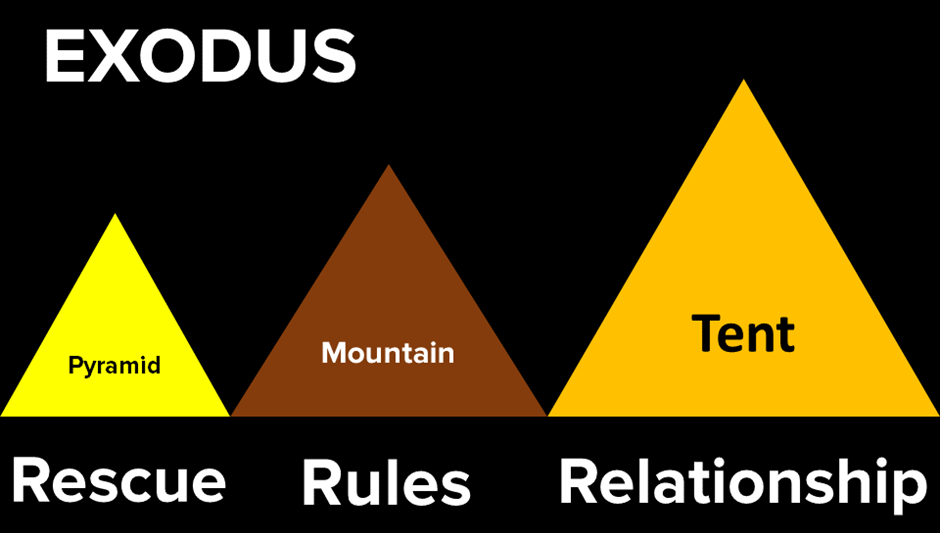
The first part of Exodus is about the LORD redeeming them, then the LORD gives them the law at Mount Sinai and then the tabernacle (a mobile Mount Sinai) so that the LORD will live with his people. The people are not saved by obedience. They are saved for obedience.
4. FOUNDATIONAL
The 10 words at the mountain are the founding of God’s people. They are heavenly words - they are directly from God to the people (unlike the rest of the law that is given to Moses), and they are how to be like God.
This God is holy, and the 10 words are how his people he has made holy (Exodus 19:6), they are to be his holy people (Leviticus 11:45). This is about loving like the God who is loving. Later in Deuteronomy, the law is summarised like this: ‘Love the LORD your God with all your heart and with all your soul and with all your strength.’ (Deuteronomy 6:5). The Lord Jesus quotes this, along with: ‘Love your neighbour as yourself,’ (Leviticus 19:18), as the summary of the whole law (the 10 words and the laws that applied it to the people of Israel). Sure enough, the 10 words break into two: 1-4 Love God and 5-10 love his people and they express both:
- What it means to be God’s.
- And what it means to be God’s people.
This founding of God’s people is about a relationship of love with the LORD and each other. In fact, meeting God at Mount Sinai is later described in the prophets as a marriage covenant.
These 10 words written on the tablets of stone will be kept, uniquely, in the ark of the covenant, at the heart of God’s dwelling place - the tabernacle and later the Temple. The dwelling place of God houses the law of God. Later, the Lord Jesus, the dwelling place of God, will have the law written on his heart!
5. SIMPLE
Children can understand the 10 words. The heavenly words are not stuck up in the clouds, they are down to earth, understandable, practical, and real.
But what about all the other laws that flow out from the 10 commandments? We tend to think that the Old Testament law was complicated, overwhelming and incomprehensible. But that’s really not the case. People reckon that if you count all the laws from these first five books of the Bible there are 613 laws in total. Even then the 613 don’t apply to everyone; for instance, some are just for priests.
If 613 sounds like a lot, then take a moment to think about how much law we have in the UK. When I first looked into this:
- There were 3390 Public General Acts of Parliament. Just one of these, number 3113, The Traffic Signs Regulations and General Directions 2002, printed out would be 462 pages.[3]
- Then there’s secondary legislation. In just one year, 2012, 3,328 secondary regulations were passed.
- Then there’s all the cases, text books and academic articles that discuss their interpretation. They count as law too.
- And then there’s all the common law - the law declared by judges, derived from custom and precedent.
- My lawyer friend said that it’s generally held that the whole law library probably counts as law.
UK law is massive, confusing and difficult to obey. But here in Exodus 20 are 10 simple, understandable commandments, with only 603 laws applying them to Israel’s life.
That’s the first five of my 10 words about God’s 10 words.
- Serious
- Creational
- Post-salvation
- Foundational
- Simple
Read the next post on 6-10 here.
[1] I’m going for Laban for Word 9 here – he’s the bad guy in the Jacob story, (not Jacob) – he says he will give Jacob his daughter, Rachel, but instead gives his other daughter, Leah. Abraham is a big sinner in Ur, worshipping other gods (Joshua 24:2), before the LORD calls him, and in Genesis 16 when he ‘falls’ by listening to his wife, and taking Hagar. But I don’t think Abraham is breaking the ninth commandment when he says Sarai is his sister to Pharaoh in Genesis 12 and Abimelech in Genesis 20. Get in touch if you want to me to explain why I think that!
[2] Also at Moriah, Abraham is like Israel – he is tested (Genesis 22:1) and he fears God (Genesis 22:12) – see Exodus 20:20.
[3] https://www.legislation.gov.uk/uksi/2002/3113/made/data.pdf