
10 words for God's 10 words - part 2
By Gerry Straker, 09 Feb 2024

How are Christians to understand God's 10 words (what the Bible calls the 10 commandments) he gave at Mount Sinai to Moses? We know God's Word is for us and important, but we often get confused about how they are important for us today. This Spring 2024 at Church by the Bay for 10 weeks we are looking at the 10 words from Exodus 20:1-17 on Wednesdays in our C3 teams. This is the second of two post on 10 words on God’s 10 words to help us. The first article is on numbers 1-5 is here.
6. MAXIMAL
The 10 words are simple, but they are also very deep. They are simple to understand but not simple to obey, because they have always been about the heart. The 10th word says this: ‘You shall not covet your neighbour's house. You shall not covet your neighbour's wife, or his manservant or maidservant, his ox or donkey, or anything that belongs to your neighbour.’ (Exodus 20:17) That’s a law about the heart and it is Paul’s area of struggle in Romans 7.7-25.
Maybe you might think you could obey the first 9 if they were just in an external sense – don’t murder for instance. Many of us will be able to keep that commandment when taken simply as a commandment about our actions. But the word 10 teaches us that the law is about the heart.
And that’s how Jesus teaches the commandment about murder was in a maximal sense, it included not being angry with your brother in your heart (Matthew 5:22). Later John writes: ‘anyone who hates his brother is a murderer.’ (1 John 3:15).
The law was always about the heart and to be understood in the maximal sense! Jesus attacks the Pharisees because they have taken the 10 words and given them the thinnest possible understanding. Here’s an example - say you’re married but you want to take another woman. The Pharisees said: don’t commit adultery! But divorce your wife so you can marry the other woman! Jesus says lust is adultery in the heart (Matthew 5:27-28) – the 7th word includes lust. Jesus has a maximal understanding of the 10 words.
It was never just about external obedience. It was always about heart obedience! God has always wanted people’s hearts! (Deuteronomy 10;16; 30:36) He has always wanted faith in Him that has led to heart obedience!
The Pharisees tried to make obeying the law possible. But the truth is, obeying the law is…
7. IMPOSSIBLE
The Bible is clear that we cannot keep God’s law.
- Woe is me for I am lost. (Isaiah 6:5).
- The human heart is deceitful above all things and desperately sick. (Jeremiah 17:9).
- No one is righteous. (Romans 3:10).
- All have sinned and fall short of the glory of God. (Romans 3:23).
- The natural man is dead in trespasses and sin. (Ephesians 2:1).
- By nature we pass our days in malice and envy, hated by others and hating one another. (Titus 3:3).
The 10 words meet sinners and calls us to obey God’s standards and it is impossible. The law is a mirror to show us the reality of who we are.
As Paul writes, ‘So then, the law is holy, and the commandment is holy, righteous and good,’ (Romans 7:12), - the problem is we are unholy, unrighteous, and bad! The law shows us what we are like and shows us our need of Christ.
Obeying the 10 words fully is impossible. But in another sense, obeying the 10 words is…
8. POSSIBLE
We need to be careful here! Because it really is impossible to obey the 10 words, and it really is wicked to think that you can (remember the Pharisees)! When I say the obeying the 10 words is possible, I don’t mean ‘personal, perfect, perpetual, obedience.’[1]
But, consider Zechariah and Elizabeth: ‘Both of them were upright in the sight of God, observing all the Lord's commandments and regulations blamelessly.’ (Luke 1:6). Simeon is described in a similar way: ‘Now there was a man in Jerusalem called Simeon, who was righteous and devout.’ (Luke 2:25). How can this be, given what the Bible says about all humanity under our seventh heading ‘Impossible’, above?
The only way to be righteous in the Bible is by faith - total dependence on God to keep his promises of blessing. Then comes obedience. Abraham believed the LORD, and the LORD credited it to him as righteousness (Genesis 15:6). Faith in God’s promises means God gives Abraham the status of righteousness. Then Abraham starts to obey and is later described like this: ‘Abraham obeyed me and kept my requirements, my commands, my decrees and my laws.’ (Genesis 26:5). From the rest of the Bible, we know it is the Holy Spirit who has given him this faith, and who helps him to obey. Faith in God to do all the work for salvation, leads to obedience to God’s law - which is also God’s work!
Zechariah, Elizabeth and Simeon are people of faith – because they are longing for God’s promise of a Saviour: they know they need help!
'Zechariah was filled with the Holy Spirit and prophesied: 68 "Praise be to the Lord, the God of Israel, because he has come and has redeemed his people. 69 He has raised up a horn of salvation for us…”’ (Luke 1:67-69)
Simeon… was waiting for the consolation of Israel, and the Holy Spirit was upon him. (Luke 2:25).
They are thrilled that God has kept his promises and brought their Saviour and they welcome Jesus! They have faith. They are looking for the Saviour. Meantime, with God’s help they do their best to keep the law.
So how was keeping the 10 words possible?
- Realising you can’t obey.
- Looking to the Saviour in faith.
- With God’s help living the life of faith and obedience.
This is what Abraham, Zechariah, Elizabeth and Simeon did. So, if a Jew was looking to get to God through his obedience, if he approachs the law with his obedience: impossible. On the other hand, if a Jew knew he could not get to God though his obedience and he knew he needed the promised Saviour, if you approach the law with faith: possible.
9. FULFILLED
But only possible because the law points to our great Saviour, Jesus Christ, the true Israelite, the true obedient Son of God.
The Lord Jesus Christ was sent from God to fulfil the law. (Matthew 5:17) He obeyed His Father’s commands. (John 15:10), He obeyed the law perfectly, He never sinned, He kept the 10 commandments with all his heart in every situation he faced (Hebrews 4:15; 1 Peter 2:22; 1 John 3:5). Jesus is the one to whom the whole law points. Jesus is the law-keeping Messiah who dies for law-breakers, as he bears the curse of the law. (Galatians 3:13).
Jesus fulfilled the law, obeying it fully and dying for those who broke it and commands to obey the law. Forgiven people in His kingdom are to obey the King! This means the 10 words are….
10. PROPER
By this 10th word ‘proper’ I mean: good, right, important, vital, necessary for Christians.
a. The prophets tell us
‘In the last days the mountain of the LORD's temple will be established as chief among the mountains; it will be raised above the hills, and all nations will stream to it. Many peoples will come and say, "Come, let us go up to the mountain of the LORD, to the house of the God of Jacob. He will teach us his ways, so that we may walk in his paths." The law will go out from Zion, the word of the LORD from Jerusalem. (Isaiah 2:2-3).
"This is the covenant that I will make with the house of Israel after that time," declares the LORD. "I will put my law in their minds and write it on their hearts. I will be their God, and they will be my people. No longer will a man teach his neighbour, or a man his brother, saying,`Know the LORD,' because they will all know me, from the least of them to the greatest," declares the LORD. "For I will forgive their wickedness and will remember their sins no more." (Jeremiah 31:33-34)
We’re promised forgiveness first, then we can obey. God’s law doesn’t change, but the hearer of the law is changed. What God wrote on the stone tablets, God promises to write on the hearts of his people.
b. Jesus tells us
"`Love the Lord your God with all your heart and with all your soul and with all your mind.' This is the first and greatest commandment. And the second is like it:`Love your neighbour as yourself.' All the Law and the Prophets hang on these two commandments." (Matthew 22:37-40).
Jesus quotes from Deuteronomy and Leviticus to give us a summary of the 10 words: Love God (1-4) and love your neighbour (5-10).
c. Paul tells us
‘Let no debt remain outstanding, except the continuing debt to love one another, for he who loves his fellow-man has fulfilled the law. The commandments, "Do not commit adultery," "Do not murder," "Do not steal," "Do not covet," and whatever other commandment there may be, are summed up in this one rule: "Love your neighbour as yourself." Love does no harm to its neighbour. Therefore love is the fulfilment of the law.’ (Romans 13:8-10)
This ancient law, built into the fabric of creation, teaching us to be like God is of course for us! It’s for everyone! Maybe this diagram will help:
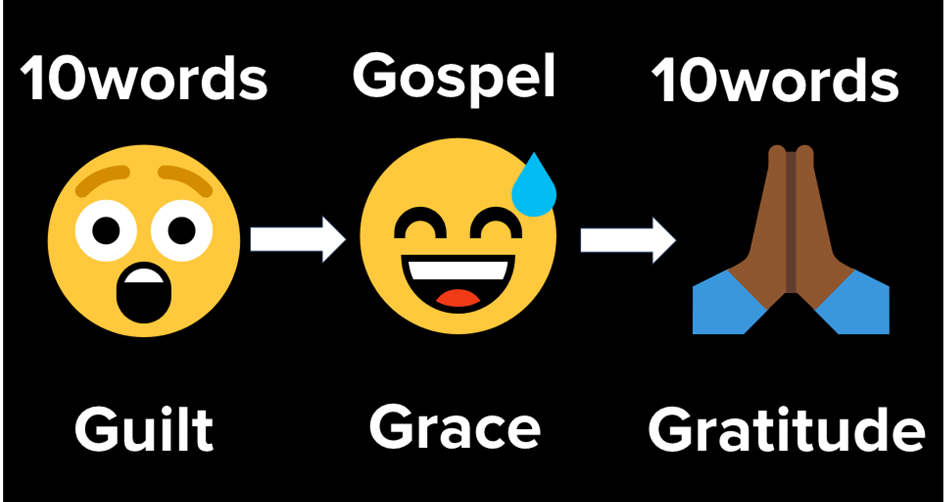
The 10 words don’t change, but we do! We can’t obey (guilt), we’re saved (grace), so we live lives of obedient thankfulness (gratitude). John Duncan (1796-1870) a minister in the Free Church of Scotland and missionary to Jews in Hungary said this: ‘The best preaching is: believe on the Lord Jesus Christ and keep the ten commandments.”[2] We obey the 10 words because we’ve received the grace of the Lord Jesus, and with the Spirit’s help. My old tutor David Field paraphrases Puritan John Dod like this: ‘The law is my enemy if God is my enemy, but if God is my friend, then the law is my friend.’
Through grace, God is my friend, and so the law is our friend too. The 10 words are how to live the life we were designed to live, to enjoy family life with our Father.
Never make the mistake of thinking obeying the law is walking to God. The grace of the gospel of Jesus Christ brings us to God. Obeying the law is walking with God. Again, the 10 words are not the road to God, they are the road with God.
Our Father loves us, so he tells us to live the best life. We love our Father by obeying the 10 words. Jesus’ summary of the law remember, begins like this: ‘Love the Lord your God…’ John writes: ‘This is love for God: to obey his commands. And his commands are not burdensome.’ (1 John 5:3)
Our situation is not the same as Israel as a nation so some of the applications of the 10 words have changed, but God hasn’t changed, the moral fabric of the universe hasn’t changed, because it is his. Justice is found in God and He hasn’t changed! The 10 words haven’t changed.
The Holy Spirit writes the same law on our hearts and with the Spirit’s help we can start to obey this law.
CONCLUSION
10 words about God's 10 words:
- Serious
- Creational
- Post-Salvation
- Foundational
- Simple
- Maximal
- Impossible
- Possible
- Fulfilled
- Proper
Of course you can debate my 10 words about the LORD’s 10 words:
- There are more that I could have given you.
- You may have better words to sum up what I was trying to say.
But I hope I’ve shown you something of how important they were, how important they were for Jesus living the obedient life so he could die for the disobedient, and how important they are now for God’s people.
I pray this will prove to be a really great term looking in depth at these 10 words and how they reach back to creation and forward to the new!
[1] See the Westminster Larger Catechism Question 20 for this phrase.
[2] https://www.fpchurch.org.uk/publications/the-free-presbyterian-magazine/1998-to-2003/july-2003/rabbi-duncan-alexander-moody-stuart-659/